Blood Rage Board Game: Rules, Strategy & Expansions
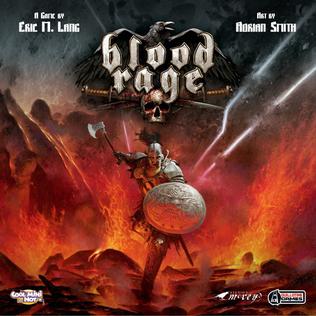
Blood Rage is a competitive Viking-clan game built around card drafting and conflict on a shrinking map. Players pursue glory across three Ages, choosing upgrades, quests and battle cards that shape their clan’s scoring plan. Winning fights is one route to glory; particular abilities can make deliberate losses or destruction profitable too.
Researched game guide. Facts and rules checked on September 12, 2026. Strategy and complexity assessments are editorial analysis; this page does not claim hands-on testing. Read our editorial policy.
On this page: Game facts · Who it suits · Rules overview · Strategy · Common questions · Expansions · Related games · Sources
Blood Rage: quick game facts
| Attribute | Base-game information |
|---|---|
| Players | 2–4 |
| Publisher play time | 60–90 minutes |
| Publisher minimum age | 14+ |
| Designer | Eric M. Lang |
| First release | 2015 |
| Original publisher | CMON |
| Complexity | Medium to heavy — editorial assessment |
| Main mechanisms | Card drafting, area control and variable clan upgrades |
| Theme | Viking clans and Ragnarök |
Player count, age and duration follow the official Asmodee product listing. This guide covers the original English base game with FAQ 1.1, dated June 2016. Promotional monsters and expansions can introduce exceptions. The listed 49 miniatures are the base set’s total figures, including monsters; they are not 49 Viking warriors.
Who Blood Rage suits
Consider Blood Rage if your group enjoys direct competition and discovering combinations between drafted cards. A strong position matters, but opponents’ hidden cards can change what a battle means. Discuss that uncertainty when introducing the game to someone who expects the largest army to guarantee a win.
It is a less comfortable choice for a group that dislikes attacking other players or reading unfamiliar card effects under pressure. The distinction between a battle result and a scoring result also needs attention: losing is only useful when a rule, ability or wider plan gives you a reason to want it.
How the three Ages work
Set up the map and card decks for your player count; the two-player drafting procedure differs from the usual draft. Each Age includes drafting, actions, discarding, quest resolution, Ragnarök and release from Valhalla. During actions, players take turns invading, marching, upgrading, committing quests or attempting to pillage, subject to their Rage and card effects.
A pillage can bring nearby clans into a battle. Participants reveal battle cards simultaneously and compare total strength. The highest strength wins; a tie means everyone loses. Defeated figures normally enter Valhalla. Ragnarök destroys the marked province, and released Valhalla figures return to their reserves at the end of the Age.
Glory can come from battles, completed quests, destruction and card abilities. After the third Age, add the applicable final clan-stat bonuses. The highest glory total wins. Read the full rulebook for action costs, strength calculations and exactly which losses score.
The official English rulebook is the authority for the full procedure. Keep card text and the publisher FAQ available when resolving exceptions; a broad summary cannot replace a specific ability’s timing.
Blood Rage strategy: draft a scoring plan
Editorial analysis: Ask how a drafted card will contribute to glory with the cards you already hold. An individually impressive monster or battle card can be less useful than an ordinary-looking card that completes a plan you can afford and execute.
Plan the sequence, not just the final battle. Getting a figure into position, paying for an upgrade and keeping the right card can compete for the same Age’s opportunities. Before committing to a combination, identify what must happen first and what an opponent could disrupt.
For example, a card that rewards losing a battle does not mean every loss is a good move. Compare the glory it earns with the position you surrender, the opponent’s reward and the chance you had to complete a quest instead. Sometimes accepting a loss advances your plan; sometimes it simply helps the leader.
Look at the province marked for destruction before spending effort defending it. Its value may come from a quest, a pillage opportunity or a destruction reward rather than from holding it indefinitely. Explain that goal to yourself before adding more figures.
Watch which parts of a plan are visible. Opponents can see clan upgrades and positions even when they cannot see battle cards. If your plan depends on getting a particular kind of fight, consider whether they have an incentive to provide it. These are strategic deductions, rather than session-tested recommendations or a claim about the strongest card in every draft.
Common Blood Rage rules questions
Is the board cleared after each Age?
No. The official FAQ says surviving figures stay on the board and pillage tokens reset. The release from Valhalla returns figures that were there to their reserves; it does not remove every survivor from the map.
Does an uncontested pillage award Battle Glory?
No. You can receive the province’s pillage reward without a battle, but you do not receive Battle Glory when no battle happened.
Can defeated figures retreat instead of being destroyed?
There is no general retreat choice for ordinary defeated figures. A particular monster or expansion ability may provide an exception. Do not apply an exception printed on one card to every clan.
Does every defeat give glory?
No. Check the specific effect that awards glory. A loss in battle and destruction by Ragnarök are different events; rewards tied to one do not automatically apply to the other.
Is a fully improved stat worth 20 or 30 bonus glory?
Twenty. The FAQ clarifies that the final stat award is not the lower ten-point award plus twenty more.
Blood Rage expansions
| Product | Relationship |
|---|---|
| 5th Player Expansion | Adds the capacity and components for a fifth player; requires the base game. |
| Mystics of Midgard | Adds mystic figures and associated rules; requires the base game. |
| Gods of Asgard | Adds gods and province effects; its additional interactions are covered in the official FAQ. |
Check which expansions and promotional figures are present before resolving an interaction. Mystics of Midgard is the expansion’s name; “Monsters of Midgard” is not the corresponding product in this list. The base game already contains monsters.
Explore related game guides
These connections highlight a shared mechanism or planning question. Each game has its own rules and edition notes.
- Scythe — Compare shared-map decisions with a stronger economic focus and a different combat system.
- Azul — Compare hidden card-draft planning with an open tile draft.
- Rebirth — Explore contested map placement without Blood Rage’s card-driven battles.
- Browse the game library for all published game hubs.
Find complete teaching articles in our how-to-play guides, or explore strategy guides by game and decision.
Sources and edition notes
- CMON: original English Blood Rage rulebook
- CMON: English FAQ 1.1 (June 2016)
- Asmodee: base-game facts and product family
- Asmodee: 5th Player Expansion
- Asmodee: Mystics of Midgard
Correction note — September 12, 2026: Corrected the miniature description and expansion name, removed the implication of a general retreat rule, and clarified that defeat does not always award glory. Removed an undated rating and unsupported review claims.