Best desk games for two adults should deliver a satisfying duel without needing a dining table. The ideal choice fits your available space, finishes within an agreed break and remains enjoyable when played by the same pair repeatedly.
Our picks: Hive Pocket for deep abstract tactics; Skulls of Sedlec for compact card positioning; Tucano for quick competitive scoring; Love Letter for bluffing and deduction; and Sprawlopolis for two adults who prefer to cooperate instead of compete.
Editorial method: This is a research-based comparison using publisher specifications and descriptions of how components occupy a work surface. We have not physically measured each game or conducted hands-on playtests. A small box does not guarantee a small footprint once cards are laid out. Prices and stock vary by country.
Two-player desk games at a glance
| Game | Two-player style | Approx. duration | Space |
|---|---|---|---|
| Hive Pocket | Competitive abstract strategy | 20 min | Medium, expanding tiles |
| Skulls of Sedlec | Competitive card arrangement | 10–15 min | Small-to-medium pyramids |
| Tucano | Competitive set collection | 15 min | Small, three card piles |
| Love Letter | Deduction and bluffing | 20 min | Small card area |
| Sprawlopolis | Cooperative spatial puzzle | 15–20 min | Medium, expanding city |
1. Hive Pocket — best for a serious two-player duel
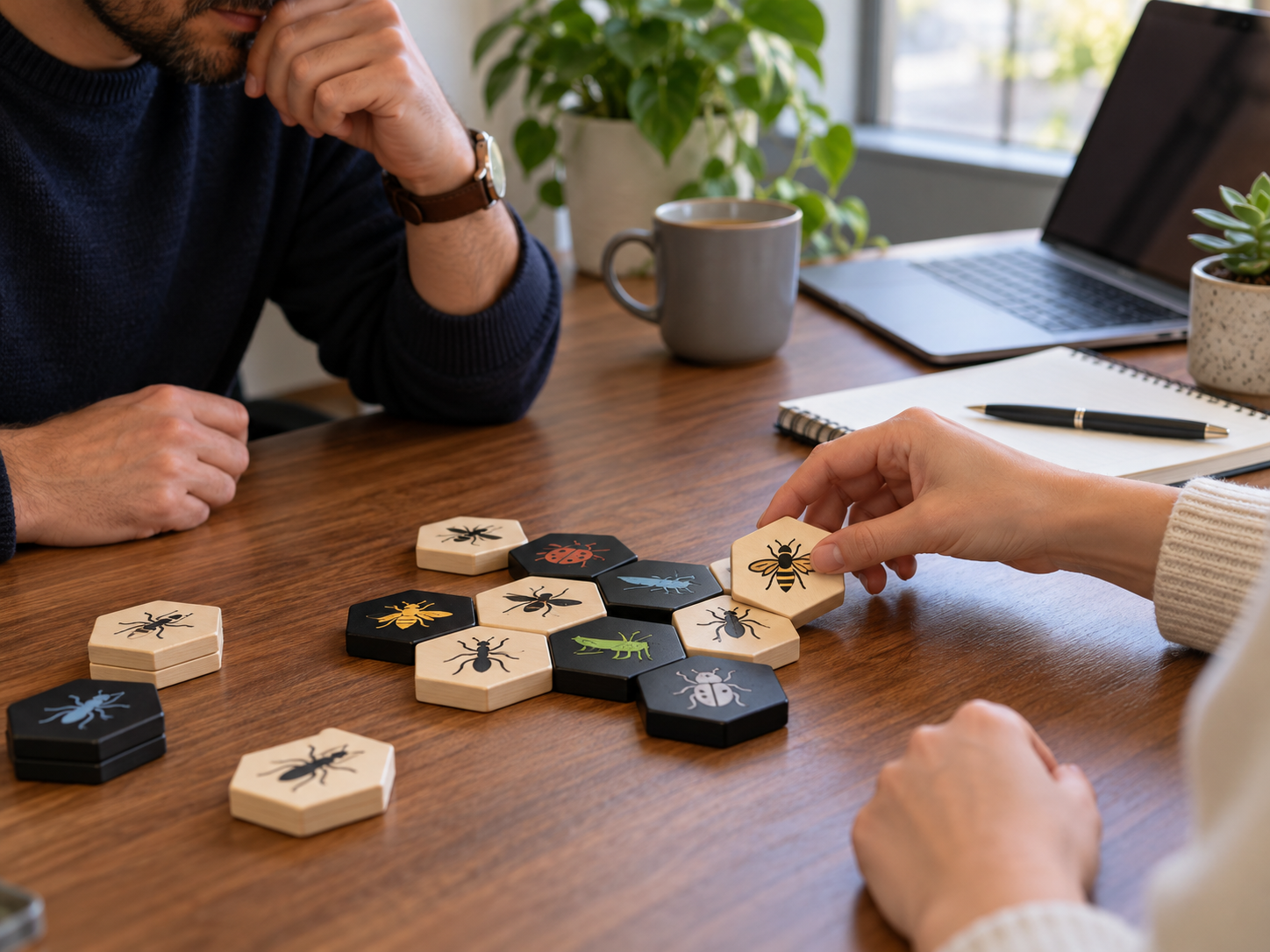
Hive Pocket is a dedicated two-player strategy game: deploy and move insect pieces to surround the opposing queen. It has no conventional board, which reduces setup, but its tile group expands as the game progresses. Choose this when: both adults enjoy long-term tactical planning and can leave a section of desk unobstructed. Skip it when: you need a game that can be packed away mid-turn in seconds.
2. Skulls of Sedlec — best for a short competitive puzzle
Draft skull cards and arrange them into compact pyramids where neighboring cards affect scoring. With two players it is a focused, accessible decision puzzle and the publisher lists 10–15 minutes. Choose this when: you want meaningful card positioning in a small package. Trade-off: the theme may not appeal to every office.
3. Tucano — best when both players are new to games
Each turn, choose one of three columns of fruit cards to collect. Some sets score differently as they grow, so decisions are more interesting than simply taking the most cards. Choose this when: you want straightforward rules and a 15-minute session. Trade-off: it has less direct strategic depth than Hive Pocket, and each player’s growing collections occupy some desk space.
4. Love Letter — best for two-person deduction
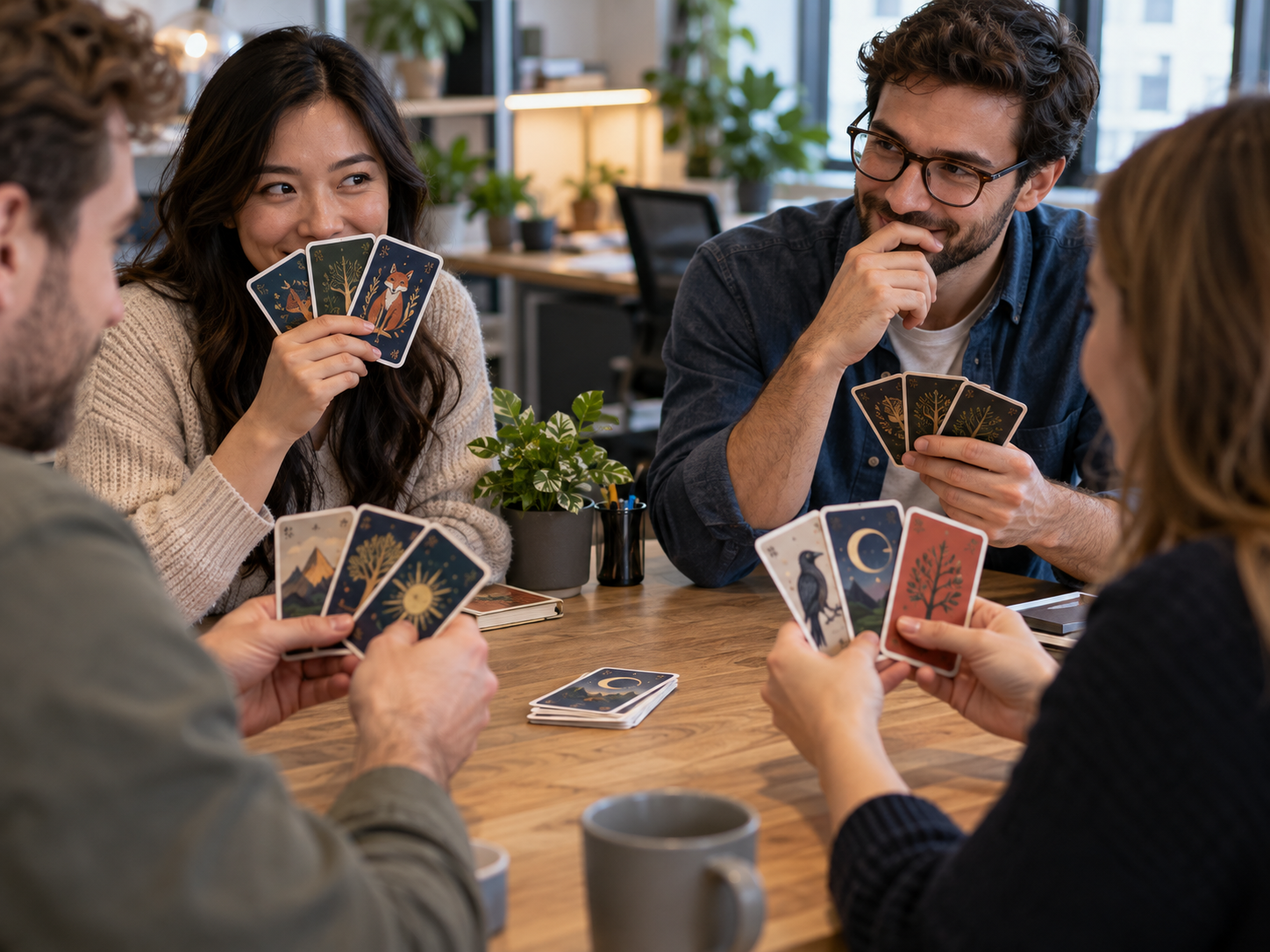
Love Letter supports two players in its modern edition and uses a small card area. Draw and play a card while making educated guesses about the opponent’s remaining card. Choose this when: conversation, bluffing and uncertainty are more appealing than moving tiles. Trade-off: the experience differs from a larger-group game; some social dynamics are naturally reduced with only two players.
5. Sprawlopolis — best cooperative game for two adults
Not every two-player desk game needs a winner and loser. Sprawlopolis asks players to build a shared city of just 18 cards while balancing shifting scoring requirements. Choose this when: you prefer solving a puzzle together. Trade-off: despite its wallet-sized package, the overlapping city layout requires table space.
Competitive or cooperative? Choose the right two-person experience
The biggest difference between these recommendations is not box size: it is how the two players interact. If you want a rematch and a clear winner, choose a competitive title. If you prefer solving a shared problem, choose a cooperative one.
| What both players want | Choose | What makes it different |
|---|---|---|
| Pure head-to-head tactics | Hive Pocket | Position, movement and forcing the opponent to react |
| Quick spatial contest | Skulls of Sedlec | Draft choices and arranging cards to score |
| Easygoing card decisions | Tucano | Choosing visible fruit piles and optimising sets |
| Bluffing and reading one opponent | Love Letter | Hidden information and deductions |
| Solving a puzzle as a pair | Sprawlopolis | Working together on a city-scoring objective |
Office-specific trade-off: Hive Pocket and Skulls of Sedlec work best when the pair can finish the match. For a relaxing conversation, Love Letter is lighter but asks players to keep track of hidden information. Sprawlopolis is a better choice if competition could make the break less enjoyable.
How to choose: a practical two-person decision guide
- For competition and minimal randomness: Hive Pocket.
- For the shortest competitive puzzle: Skulls of Sedlec.
- For easy rules and collecting sets: Tucano.
- For reading your opponent: Love Letter.
- For teamwork rather than rivalry: Sprawlopolis.
Before buying, clear the usable desk area and think about interruptions. A small box doesn’t make a game suitable for every workstation.
Two-player desk game FAQs
What is the best strategy desk game for two adults?
Hive Pocket is our leading choice for dedicated head-to-head abstract strategy because it is specifically designed for two players and requires no game board.
Can two adults play Love Letter?
Yes. The current Asmodee edition supports two to six players, although the social dynamics differ between a pair and a group.
What if we want a cooperative game?
Sprawlopolis supports one to four players working toward a shared score, including two adults playing together.
Which two-player desk game is shortest?
Among these choices, the publisher lists Skulls of Sedlec at 10–15 minutes. Allow extra time for first-time setup and explanation.
For other situations, visit Best Desk Games for Adults and Best Mini Desk Games for the Office. Our two-player board game collection covers games that need larger tables.
Sources, methods and editorial standards
Publisher specifications: Gen42, Button Shy Skulls, Helvetiq, Asmodee, and Button Shy Sprawlopolis. Checked October 2026. Descriptions of desk suitability are reasoned editorial assessments rather than physical testing. No affiliate links are included. See our editorial policy.
How this article was produced: AI-assisted drafting and original illustrative artwork were used to organise this research-based guide. Game details are attributed to linked publisher resources; the office-fit assessments are editorial interpretations of the stated components and gameplay. We did not test the games in person, measure their playing areas or use images of the actual products as proof of testing. Check the specific edition’s publisher listing before purchase. How we correct inaccuracies.