Looking for desk games for adults? A good office-desk game should be easy to set up, short enough for a break and manageable beside a keyboard. That is different from merely having a small box: some pocket-sized games still spread across a large table.
Our shortlist focuses on games you actually play on a desk, not decorative fidget toys or computer games. We compare the space they need in play, likely disruption in a shared office, player count and the trade-offs that matter when choosing one.
Quick picks: Hive Pocket for a two-player thinking game; Love Letter for a simple group card game; Spot It! for a very short, lively break; Agropolis for solo planning; and Naturopolis for a compact cooperative puzzle.
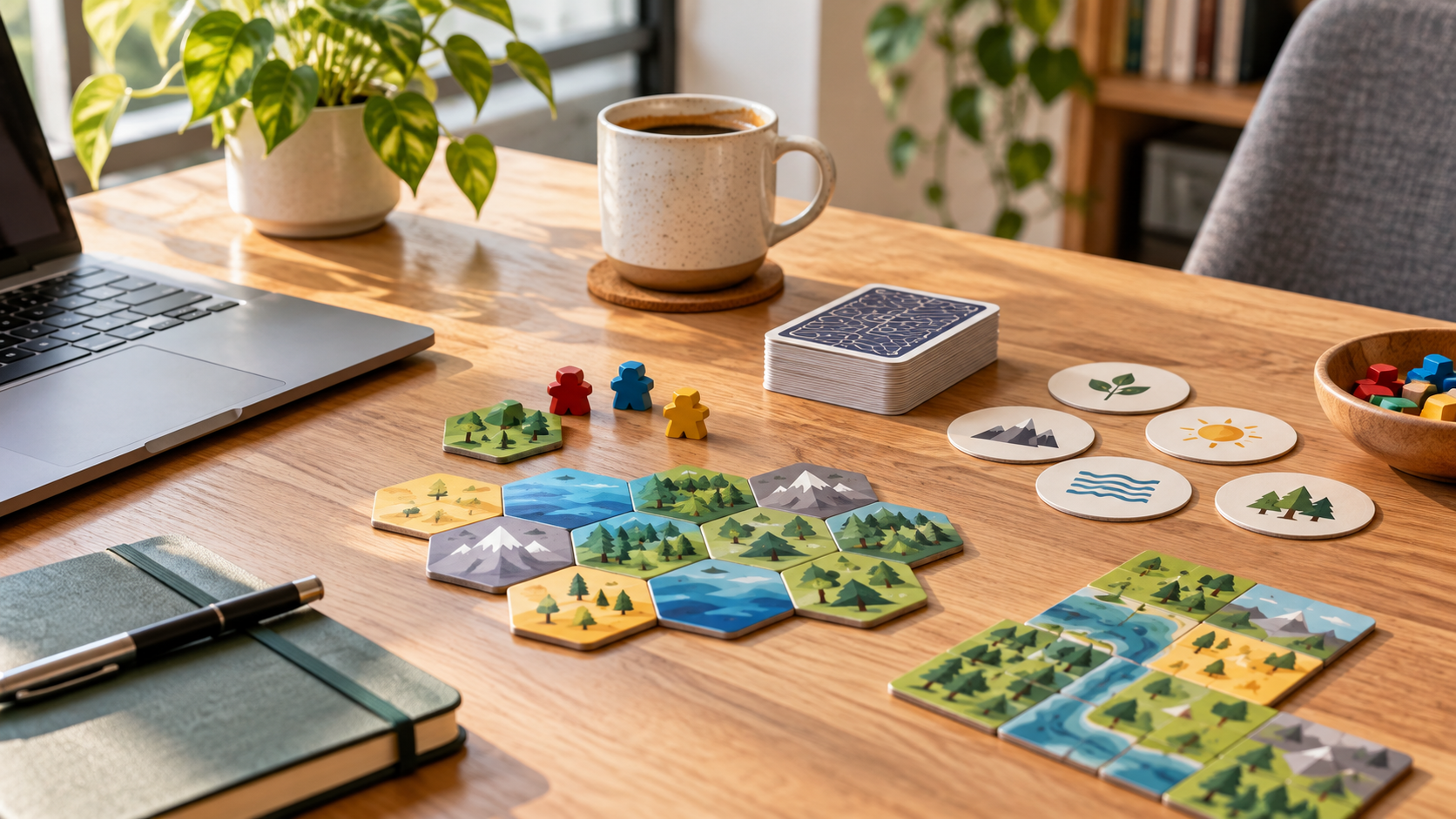
Desk games compared: space, time and office suitability
| Game | Players | Publisher play time | Desk footprint (editorial assessment) | Best use |
|---|---|---|---|---|
| Hive Pocket | 2 | 20 min | Medium: tile group grows outward | Quiet two-player strategy |
| Love Letter | 2–6 | 20 min | Small: cards and a discard area | Conversation and deduction |
| Spot It! Classic | 2–8 | 15 min or less | Very small card area | Fast energetic break |
| Agropolis | 1–4 | 15–20 min | Medium: growing card landscape | Solo or cooperative planning |
| Naturopolis | 1–4 | 15–20 min | Medium: growing card landscape | Compact spatial puzzle |
Important: “Desk footprint” is our qualitative assessment based on the game’s components and layout, not a manufacturer-measured minimum area or a claim of hands-on measurement. Leave room for your laptop, mouse, drinks and coworkers; check the playable area before buying.
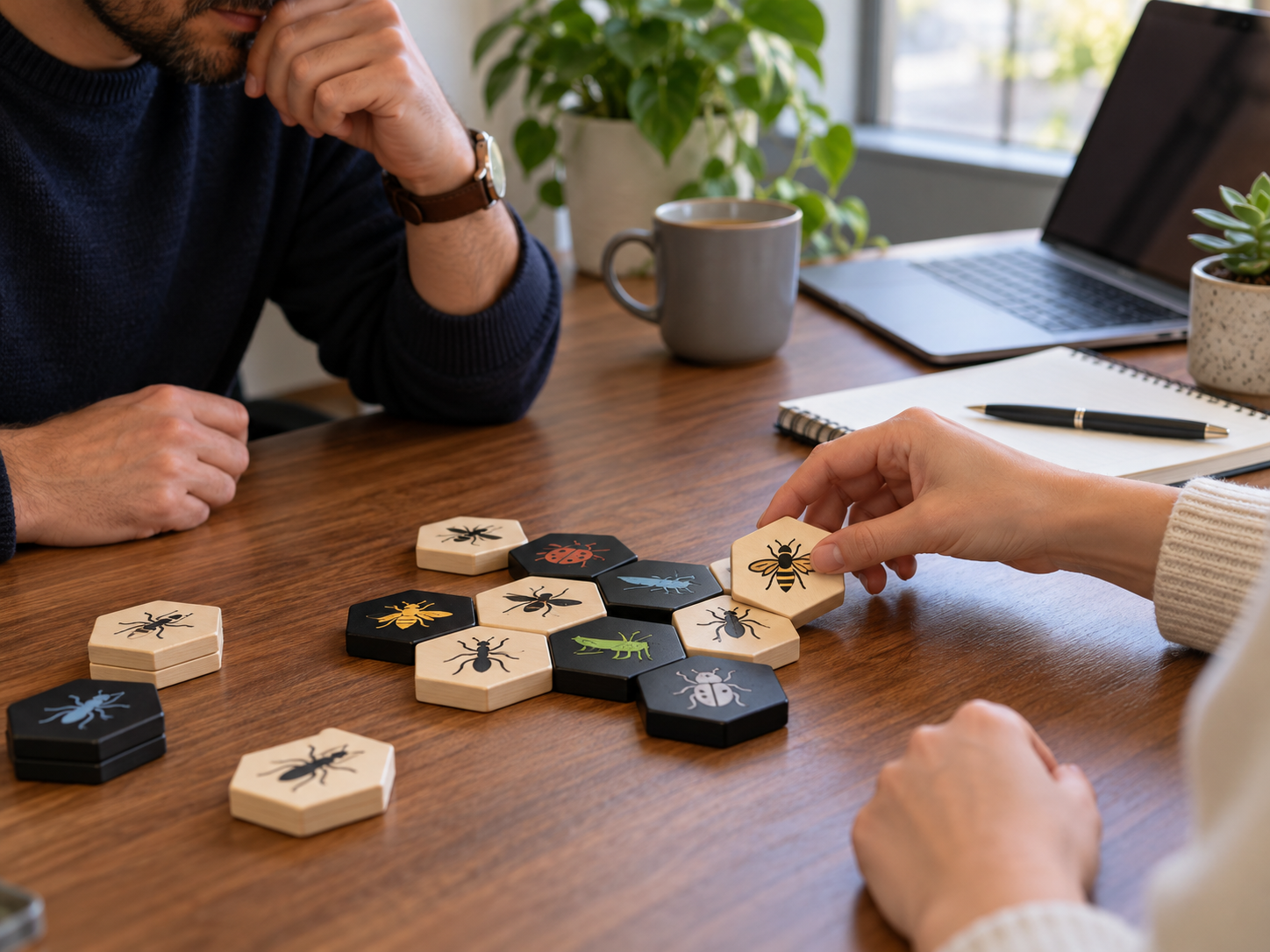
1. Hive Pocket — best for two adults who enjoy strategy
Why it fits: Hive Pocket replaces cards and a board with durable hexagonal pieces. You build a connected insect hive, moving pieces to surround your opponent’s queen bee. It takes little setup and supports a satisfying head-to-head decision space.
Desk caveat: The hive expands as pieces enter play, so a very narrow workstation may be uncomfortable. It requires two players and is less suitable when colleagues are regularly interrupted.
Who should choose it: Two coworkers or friends who want quiet abstract strategy without a large game board. The publisher lists two players and about 20 minutes. Publisher information.
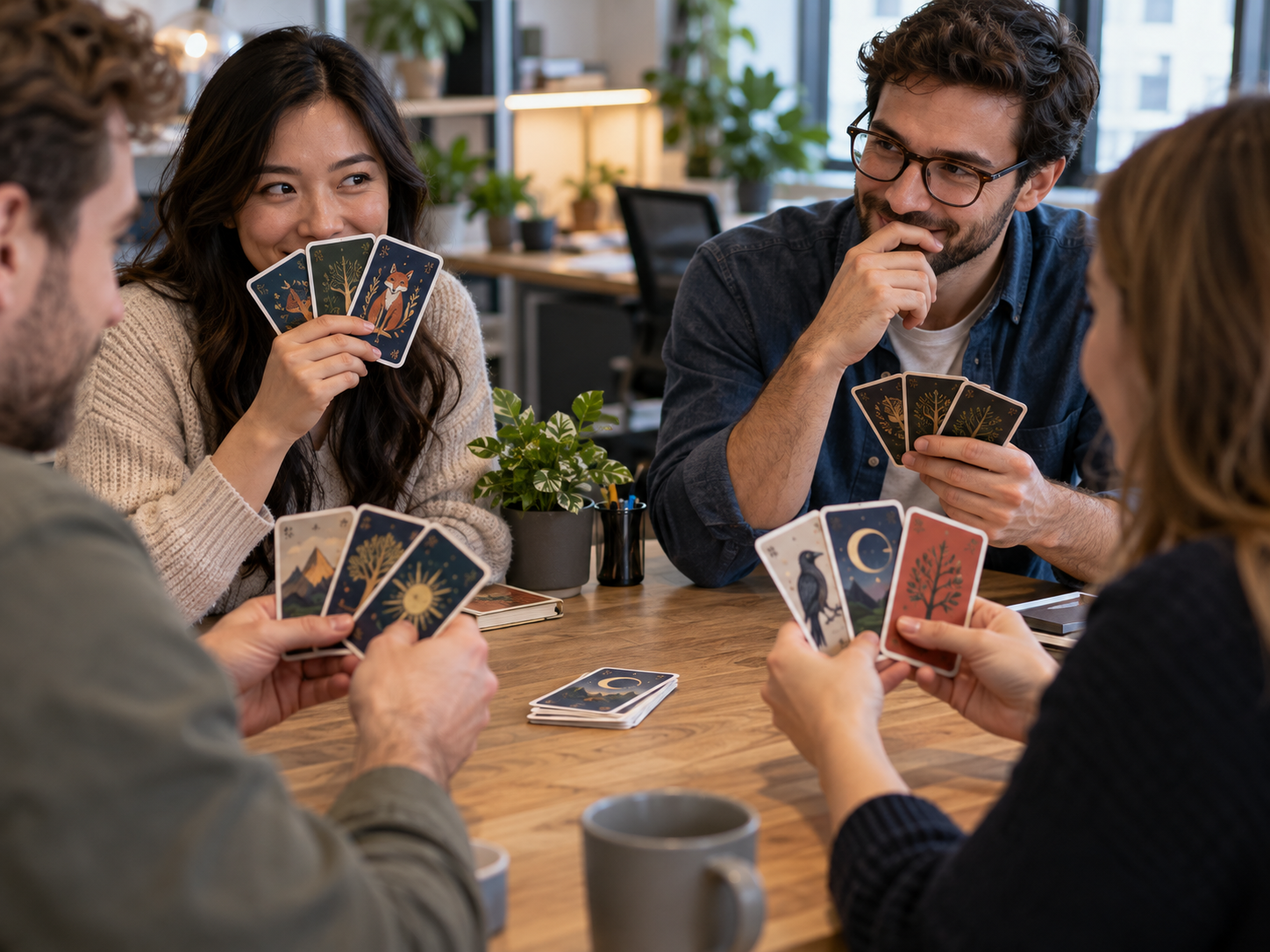
2. Love Letter — best for a small office group
Why it fits: A compact deduction card game with simple turns and a small common play area. Players work with limited card information and try to outlast or outguess opponents. The current Asmodee edition supports two to six players.
Desk caveat: Conversation and bluffing are part of the appeal, so this is better in a break room or a quiet social break than beside people on calls. A group round and the full session can have different lengths.
Who should choose it: Adults who want approachable social deduction rather than a long tactical puzzle. Publisher duration: approximately 20 minutes. Publisher details.

3. Spot It! Classic — best for a five-to-fifteen-minute break
Why it fits: Players race to spot matching symbols on cards. The cards occupy very little surface area, and the rules are short enough to teach during a brief break.
Desk caveat: This game is exciting precisely because it rewards quick reactions; it can become loud. It is a poor choice for a shared office where other people are concentrating.
Who should choose it: Groups seeking a short activity in a designated social space. The publisher lists 2–8 players and 15 minutes or less for Spot It! Classic. Publisher specifications.
4. Agropolis — best for solo desk gaming
Why it fits: This wallet-format card game creates a farm landscape using card placement and scoring constraints. It works for one player, which solves the most common office-gaming problem: having nobody else available when your break starts.
Desk caveat: Small packaging does not guarantee a tiny play area. Its laid cards can spread across a desk, so it suits a temporarily cleared workstation better than a surface occupied by two monitors and paperwork.
Who should choose it: People who like deliberate spatial optimisation, solo puzzles and short cooperative challenges. Publisher specification: 1–4 players, 15–20 minutes. Publisher details.
5. Naturopolis — best for compact nature-themed planning
Why it fits: A standalone card-placement game in which you develop a landscape while balancing scoring conditions. Its short length and one-player support make it another reasonable choice for an independent break.
Desk caveat: Like Agropolis, the cards create an expanding arrangement. Avoid choosing it solely because the wallet itself is tiny.
Who should choose it: People who enjoy spatial puzzles and want a second style of portable solo-or-group card game. Publisher specification: 1–4 players, 15–20 minutes. Publisher details.
Decision guide: match the game to your workplace
| Work situation | Most suitable from this list | Why | When to avoid |
|---|---|---|---|
| Only one person free | Agropolis or Naturopolis | Solo play avoids organising coworkers | If there is not enough space for a growing landscape |
| Two people want quiet competition | Hive Pocket | Turn-taking without a shared board | If the desk must be cleared at a moment’s notice |
| Colleagues want to socialise | Love Letter | Compact cards and conversational play | When nearby colleagues need silence |
| Everyone has a very short break | Spot It! | Individual rounds can be brief | In quiet working areas due to speed and excitement |
A simple space test: Before opening a new game, move your mug away from cards or tiles; put electronics out of spill range; leave room for everyone to reach the shared area; and check that the arrangement will not block essential work. These are practical suggestions, not measurements of any particular game.
How to choose a game for your desk
- Measure the usable surface, not the desk: a 120 cm desk may have only a small clear space beside monitors and peripherals.
- Choose by real break length: a publisher’s 20-minute playing time does not necessarily include teaching, setup and putting the game away.
- Match the player count: Hive Pocket requires two; Agropolis and Naturopolis support solo; Love Letter and Spot It! suit groups.
- Consider noise: simultaneous speed games are less appropriate at active workstations than quiet turn-taking or solo puzzles.
- Think about interruptions: puzzles with an easily preserved state can be easier to resume than social deduction or reflex games.
What we deliberately left out
Large-box board games may be brilliant but are not automatically good desk games. A game with an expansive player board, multiple shared decks and extensive token supply needs a clearer space than many office desks offer. We also excluded novelty fidget products: those may be excellent desk accessories, but they do not answer the tabletop-game search intent of this guide.
Common questions about desk games for adults
What is the best desk game for two adults?
Our pick is Hive Pocket for quiet head-to-head strategy, provided you have room for the growing hive. If you want conversation and deduction instead, Love Letter also works with two players.
What is a good solo game for an office desk?
Agropolis and Naturopolis both have solo modes and short publisher-listed sessions. Their card layouts still need a cleared surface.
Are mini games always suitable for small desks?
No. Box size and table footprint are different. A wallet-sized game may form a wide card grid in play.
Which desk games work for a ten-minute break?
Spot It! can be played in very short rounds, but its energetic nature is better suited to a break area. For the other picks, allow for setup and packing away rather than relying on the stated game duration alone.
Are desk games and deck-building games the same?
No. Desk games describes where a game fits and how it is used. Deck-building games describes a mechanism involving improving a deck during play. A game can be both, but the terms are not interchangeable.
More desk-game guides: Read Best Mini Desk Games for the Office for compact storage and office-break suitability, or Best Desk Games for Two Adults for dedicated head-to-head and cooperative choices.
Continue exploring BoardGameArchive
- Best board games under 30 minutes — compare fast games beyond the desk format.
- Best board games for two players — options when space is less restrictive.
- Solo board games — more games for independent play.
- Board games for team building — activities for planned group sessions, not just desks.
Sources, selection method and disclosure
Selection criteria: tabletop play suitable for adults, publisher-listed sessions of 20 minutes or less where possible, portable components, and an identifiable reason to choose the game for a desk. Love Letter is included as an approximately 20-minute group option; actual length varies. Space and office-noise assessments are editorial judgements from the designs and components rather than physical measurements or firsthand playtests. These are independent recommendations, not an endorsement by any publisher. No affiliate links were added to this article.
Publisher specifications checked October 2026: Gen42: Hive Pocket; Asmodee: Love Letter; Asmodee: Spot It!; Button Shy: Agropolis; Button Shy: Naturopolis. Read our editorial standards and corrections policy.
How this article was produced: AI-assisted drafting and original illustrative artwork were used to organise this research-based guide. Game details are attributed to linked publisher resources; the office-fit assessments are editorial interpretations of the stated components and gameplay. We did not test the games in person, measure their playing areas or use images of the actual products as proof of testing. Check the specific edition’s publisher listing before purchase. How we correct inaccuracies.