Scythe Board Game: Rules, Strategy & Expansions
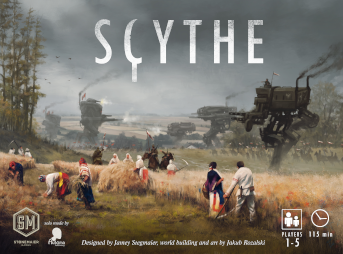
Scythe is a competitive economic and territory-control game set in an alternate-history Eastern Europe. Players run asymmetric factions, produce resources and develop an engine of increasingly efficient actions. Mechs can fight, but building a profitable economy and judging when the game might end are central to the decision making.
Researched game guide. Facts and rules checked on September 12, 2026. Strategy and complexity assessments are editorial analysis; this page does not claim hands-on testing. Read our editorial policy.
On this page: Game facts · Who it suits · Rules overview · Strategy · Common questions · Expansions · Related games · Sources
Scythe: quick game facts
| Attribute | Base-game information |
|---|---|
| Players | 1–5; solo uses Automa rules |
| Publisher play time | 115 minutes |
| Publisher minimum age | 14+ |
| Designer | Jamey Stegmaier |
| First release | 2016 |
| Publisher | Stonemaier Games |
| Complexity | Heavy — editorial assessment |
| Main mechanisms | Engine building, action selection, resource management and area control |
| Theme | Alternate-history Eastern Europe in the 1920s |
These facts follow Stonemaier’s game page and the designer’s original age and duration notes. Duration is the publisher’s estimate, not our measured session time. This guide covers the original base game with current publisher errata; expansions can change its rules and player capacity.
Who Scythe suits
Consider Scythe if your group enjoys planning a sequence of purchases and weighing economic progress against position on a shared map. Different faction and player mats make it useful to ask what your particular combination can do efficiently, rather than applying one opening to every game.
A group looking primarily for frequent miniature battles should examine the economy carefully before choosing it. It can also be a demanding first strategy game: teaching actions is only part of the job, because players must understand why popularity, territory and the end condition matter.
How a Scythe turn works
Set up the fixed base-game board and distribute faction and player mats as directed by the rulebook. Place starting pieces and track values from those mats. On a turn, move your action token to a legal section of your player mat and resolve its top action, bottom action, both or neither. If taking both, resolve the top action first.
The publisher FAQ confirms that the two actions are optional, but their order is fixed. Production and spending depend on your current mat and uncovered costs. Resources remain on territories; they are not a personal off-board stockpile.
Combat uses power and cards
Combat is resolved with secret power-dial commitments and optional combat cards, not dice or a required coin bid. By default, each participating character or mech permits one card. Add the dial and card values; the attacker wins a tie. Both sides spend their dial power and discard used cards. Losing units return to their home base rather than being permanently eliminated.
Stars end the game; coins determine the winner
The game normally ends immediately when a player places a sixth star. That player does not automatically win. Final wealth combines coins already held with star, territory and controlled-resource scoring, plus the structure bonus. Popularity determines the rate for the first three scoring categories. Consult the rulebook and FAQ for rare timing cases around the last star.
Scythe strategy: make the next two actions work together
Editorial analysis: Look for a sequence where one action supplies the bottom-row purchase on a later turn. Compare the entire sequence: moving to an efficient production location can be worth more than gaining a resource now if it reduces several future turns of gathering.
Before upgrading, deploying, building or enlisting, ask what the purchase changes in your next few decisions. A discount is valuable when you expect to use it repeatedly. A movement ability is valuable when it opens a useful location. Neither deserves automatic priority simply because it advances an achievement.
For example, imagine you can finish an engine improvement now or move pieces into safe scoring territory. If another player is close to a sixth star, the engine improvement may have no time to repay its cost. If the game is still developing, the same improvement may create several profitable turns. The right choice depends on the remaining window.
Evaluate a fight by its aftermath. Winning can leave you with fewer defensive resources, while a worker displacement can affect popularity. Ask whether the territory, resources or star compensate for the cost and whether another player can exploit your weakened position. These considerations explain a tradeoff; they are not a tested claim that combat should always be avoided.
Keep an eye on opponents’ available achievements. Counting only your own path to six stars can cause you to invest in a plan that someone else ends before it matures.
Common Scythe rules questions
Are any faction and player-mat combinations banned?
Yes. Stonemaier identifies Rusviet–Industrial and Crimea–Patriotic as banned combinations because of their power, with a stated exception for completely new players in their first game. Follow the current publisher FAQ when assigning mats.
Can I repeat the same section?
Normally, choose a different player-mat section from the previous turn. Rusviet’s ability is an exception, but publisher errata prevents using it to repeat a Factory card on consecutive turns.
Is the base-game board modular?
No. The original game uses a fixed map. The separately sold Modular Board changes that; it is not a description of the board included in the base box.
Can Scythe be played alone?
Yes, using the official Automa system and its separate rulebook. Automa procedures should not be substituted into the standard multiplayer game. Both rulebooks are linked from Stonemaier’s rules page.
Scythe expansions and accessories
| Product | What to check |
|---|---|
| Invaders from Afar | Adds Albion and Togawa and supports up to seven players with the base game. |
| The Wind Gambit | Adds airship and resolution modules; requires the base game. |
| The Rise of Fenris | Adds an eight-episode campaign and replayable modules; requires the base game. |
| Modular Board | A separate map product, distinct from the original fixed board. |
Choose added rules according to what your group wants to change. More factions, a campaign and a variable map address different needs; they are not interchangeable upgrades. Learn the base-game timing and scoring before mixing optional modules.
Where this game fits in our recommendations
Compare the decision, group size and rules demands with other games we cover. These are researched editorial shortlists; they do not claim a tested best player count.
- Engine-building board games — compare permanent discounts, repeated powers and an economic map.
Explore related game guides
These connections highlight a shared mechanism or planning question. Each game has its own rules and edition notes.
- Blood Rage — Compare shared-map conflict with drafting a clan’s scoring abilities.
- Rebirth — Explore a shared-map placement game with a shorter core turn sequence.
- Wingspan Pocket — Compare economic payback with repeated bird powers in a compact card engine.
- Browse the game library for all published game hubs.
Find complete teaching articles in our how-to-play guides, or explore strategy guides by game and decision.
Sources and edition notes
- Stonemaier Games: Scythe
- Stonemaier Games: multiplayer and Automa rulebooks
- Stonemaier Games: current FAQ and errata
- Publisher rulebook supplied with Scythe’s digital edition
- Designer’s original FAQ: age, duration and fixed-board design
Correction note — September 12, 2026: Replaced the incorrect dice-and-coins combat description, clarified the fixed base map and the distinction between ending the game and winning. Added current banned-mat and Rusviet errata; removed an undated rating.