Catan Board Game: Rules, Strategy & Expansions
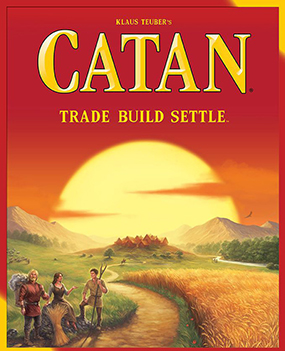
Catan is a competitive trading and settlement-building game. Dice determine which terrain produces resources, while players negotiate exchanges and spend those resources on roads, settlements, cities and development cards. The central decision is how to turn an uncertain supply of resources into a route to ten victory points.
Researched game guide. Facts and rules checked on September 12, 2026. Strategy and complexity assessments are editorial analysis; this page does not claim hands-on testing. Read our editorial policy.
On this page: Game facts · Who it suits · Rules overview · Strategy · Common questions · Expansions · Related games · Sources
Catan: quick game facts
| Attribute | Base-game information |
|---|---|
| Players | 3–4 |
| Publisher play time | 60–90 minutes |
| Publisher minimum age | 10+ |
| Designer | Klaus Teuber |
| First release | 1995 |
| Complexity | Medium — editorial assessment |
| Main mechanisms | Trading, dice-based resource production, route and settlement building |
| Theme | Settling an island |
Player count, age and duration follow the official CATAN game page; the first-release year refers to the original German game. Allow additional time for teaching. This guide covers the standard base game; expansions, scenarios and older 5–6-player rules can change play.
Who Catan suits
Consider Catan if your group enjoys bargaining, adapting to other players and building a position over several rounds. A trade can help both parties, which makes evaluating an offer more interesting than simply asking whether its exchange rate is good.
It is a less comfortable fit for a group that dislikes negotiation or wants complete control over each turn. Think about whether a player who has a poor stretch of dice rolls will still enjoy the conversation and planning. The published age is a product guideline, not a promise that every ten-year-old will enjoy trading or reading the development cards.
Rules and scoring overview
Begin with the recommended introductory layout in your edition’s rulebook. Each player starts with two settlements and two roads. Terrain produces lumber, brick, wool, grain or ore when its number is rolled; adjacent settlements receive one resource and cities receive two. A roll of seven instead resolves the discard and robber procedure.
On your turn, trade resources and pay the listed costs to build or buy development cards. Settlements are worth one point and cities two. Longest Road and Largest Army are worth two each; victory-point development cards add their printed points. You win when you have at least ten points on your own turn.
Use the official game page and rulebook downloads for the full setup, building costs and development-card timing. The publisher FAQ is useful for disputed interactions; entries about the older Special Building Phase should not be mixed into the current paired-player extension.
Catan strategy: plan around the next purchase
Editorial analysis: Work backward from a useful purchase. A road that does not lead to an available settlement site or help a realistic Longest Road attempt can consume resources without improving your position. Before placing it, identify the space or award you are trying to reach.
When evaluating starting sites, compare both the likely production and the purchases that production supports. A site with attractive numbers can still leave you dependent on trades for a resource that your opponents have little reason to sell. A balanced opening is a practical starting point, rather than a universal rule that overrides every board.
For example, suppose a trade gives you the last grain needed for a city, but gives the other player the last brick needed to occupy your only expansion site. Assess the resulting board, not just the cards exchanged. It can be sensible to decline an apparently fair trade when its timing is much better for the other player.
Keep more than one scoring plan available. Ask which points are secure, which can be taken away, and how many purchases remain before you could finish. Do not treat a temporary lead in Longest Road as if it were a permanent building. These are decision tools, not a tested opening sequence or a guaranteed winning formula.
Common Catan rules questions
Does the robber block building or trading?
No. It stops production from its occupied hex; it does not prevent construction or trading for that resource. The official FAQ also confirms that a harbor remains usable when the robber occupies the neighboring hex.
Does playing a knight make players discard?
No. The hand-size discard happens after a seven is rolled. Playing a knight moves the robber, but does not repeat that discard procedure.
What happens when Longest Road is tied?
Matching the current holder’s qualifying road does not take the award away. Another player’s settlement can interrupt a road; your own settlement does not. Check the FAQ’s separate interruption cases if several players become tied after a break.
Can two people play the standard base game?
The standard box is listed for three or four players. A two-player variant is a separate rules choice, rather than the normal base-game setup. Do not assume that removing two colors produces the intended standard game.
Catan expansions and extensions
| Product | Relationship to the base game |
|---|---|
| Seafarers | Requires the base game; adds ships and island scenarios. |
| Cities & Knights | Requires the base game; adds commodities, city improvements, active knights and barbarian attacks. |
| 5–6 Player Extension | Adds capacity for five or six players. It is distinct from a thematic expansion. |
For Seafarers or Cities & Knights with five or six players, the publisher specifies four boxes: base game, base extension, the chosen expansion and its matching extension. Check edition compatibility before mixing components. The 2025 extension uses paired-player turns; older instructions describe a Special Building Phase.
Where this game fits in our recommendations
Compare the decision, group size and rules demands with other games we cover. These are researched editorial shortlists; they do not claim a tested best player count.
- Beginner board game choices — compare the teaching hurdle and who this game may suit.
Explore related game guides
These connections highlight a shared mechanism or planning question. Each game has its own rules and edition notes.
- Ticket to Ride Europe — Compare building a network with collecting train cards for railway connections.
- Scythe — Explore economic development and territory within a more involved action system.
- Splendor — Compare resource production and trading with purchased cards that provide permanent discounts.
- Browse the game library for all published game hubs.
Find complete teaching articles in our how-to-play guides, or explore strategy guides by game and decision.
Sources and edition notes
- CATAN: official base-game page and rulebook downloads
- CATAN: official base-game FAQ
- CATAN: designer and original-release history
- CATAN: Seafarers
- CATAN: Cities & Knights
- CATAN: 5–6-player product relationships
Correction note — September 12, 2026: Updated the published play-time range, clarified the own-turn victory condition and distinguished thematic expansions from player-count extensions. Removed an undated community rating and unsupported review language.