
Magical Athlete
A playful fantasy racing board game about drafting unpredictable characters, resolving surprising powers and winning points over four races.
🏆 Magical Athlete at a glance
Magical Athlete (2025) is a competitive fantasy racing game in which players draft a team of racers with unusual powers, then compete in four separate races. Results depend on die rolls, character interactions and how wisely you distribute your team across the races.
Best for: groups who enjoy funny, unpredictable races and strategic drafting. Consider another game if: your group prefers low randomness or minimal player interaction.
Four heats, surprising powers and memorable racer combinations.
Use the updated CMYK rulebook when unusual powers interact.
♟ How the game works
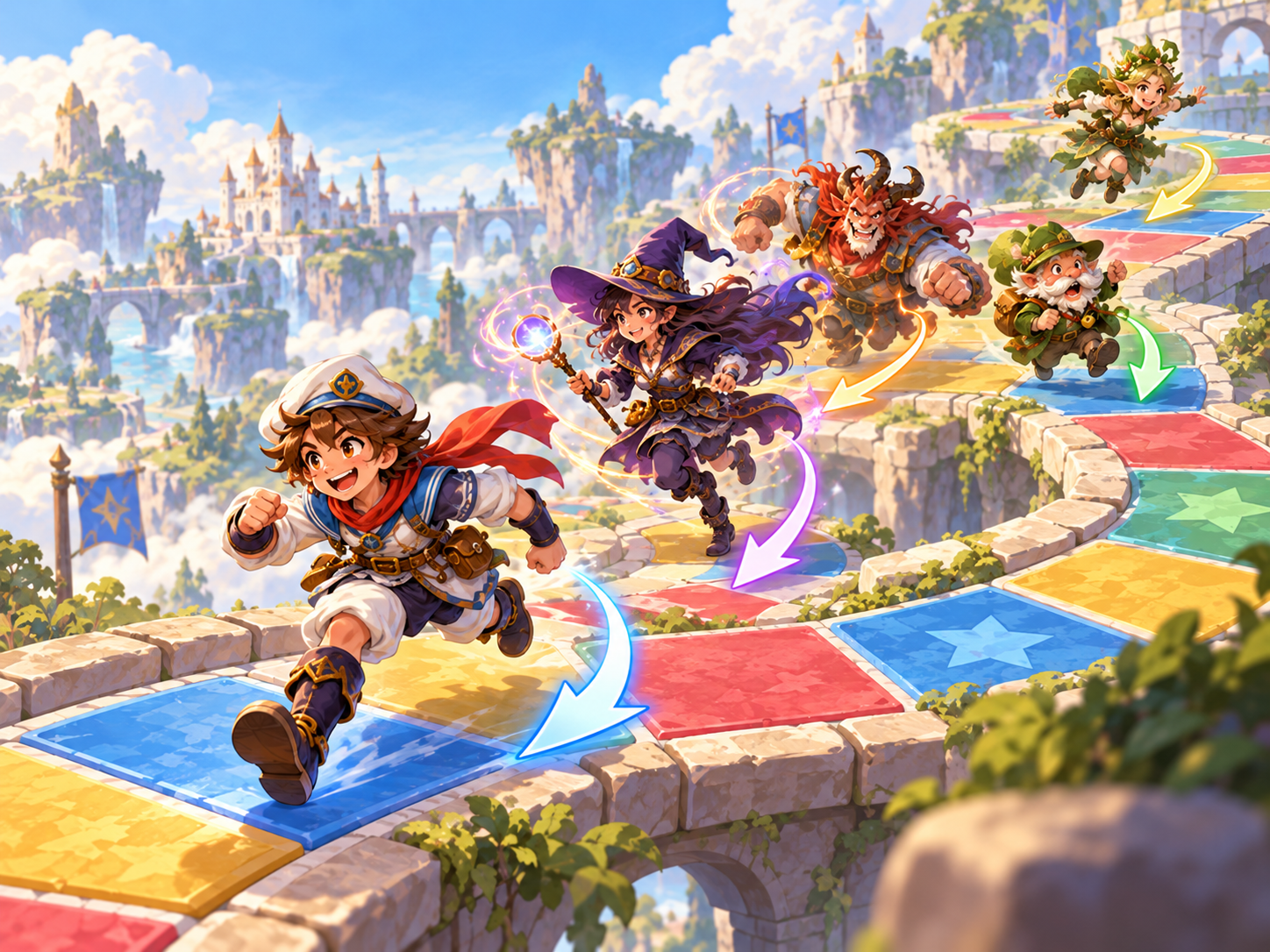
- Draft a team: recruit four racers for the four heats, following the rules for your player count.
- Choose a racer: each heat uses one unused racer from your team.
- Race: take turns rolling and moving, resolving special abilities when their conditions occur.
- Score: earn the indicated awards for top placements; after the fourth race, add all points to determine the winner.
This is a quick overview, not a replacement for the full How to Play guide.
🎯 Who will enjoy Magical Athlete?
Choose Magical Athlete if your group likes short, dramatic races in which everyone can see what is happening, the strongest-looking character does not always win, and a surprising ability can reverse the order. Drafting gives players choices before the dice start rolling.
Think twice if your group dislikes large swings of luck, powers that interfere with other players, or checking unusual interactions. The appeal comes from the unpredictable combination of racers, not from perfect control over each outcome.
What makes it different from a typical race game?
You are not committing to a single character for the entire session. Instead, you assemble a roster and decide which racer to send into each of four heats. This gives the game two connected decisions: who to recruit and when to deploy each racer.
How much of the result is luck?
Dice determine many movements, so chance matters substantially. Your decisions still influence what abilities are available, which character faces a given field, and whether you need a high-risk first-place attempt or a safer scoring finish. These are strategic choices, not promises of victory.
👥 Player counts: what changes?
The publisher lists 2–6 players for this edition. The four-race format remains the core structure, but the number of racers in a heat changes how crowded the track feels and how often proximity-based powers matter.
| Group | What to expect | Rules to check |
|---|---|---|
| 2 players | Each player operates two racers per heat, making interactions between your own racers important. | Two-player procedure |
| 3–6 players | One racer per player in each heat; larger groups create more opportunities for passing and nearby-racer abilities. | Normal racing and power timing |
| 7 or more | Outside the publisher’s listed player count; not an official supported mode. | Any larger-group variant would be a house rule. |
For two players: the recruitment and turn procedure differ from regular multiplayer. Use the dedicated two-player guide rather than applying the four-race summary without adjustments.
📦 Components and official rulebook
The 2025 CMYK game uses a double-sided race track, racer cards with individual powers, matching wooden racers, dice and scoring awards. The roster and component presentation differ from older editions. For an exact replacement-parts inventory, consult the publisher’s box contents rather than relying on a photograph or an older edition’s list.
Need the latest rulebook? Open the CMYK How to Play rules file. For answers to specific racer interactions, see our rules FAQ.
Illustration note: Images on this page are original fantasy-race artwork, not component photos or diagrams of the actual movement rules.
How to Play Magical Athlete
Use the CMYK rulebook for the 2025 game for the full draft procedure, power timing and exact point tokens. The following is a practical route through a first game.

1. Recruit a team
Prepare the double-sided track, racer cards and matching wooden racers, dice, and point awards. Draft four racers per player using the printed recruitment rules. Read the whole team before the first heat: each racer can enter only one of the four races, so a strong first pick does not solve the whole meet.
2. Reveal a racer for a race
Choose one unused racer for the current race, then set the racers on the track as instructed. Keep the racer card visible so everyone can see its power. Races are separate heats; do not bring a used racer back into a later heat unless a rule explicitly says otherwise.
3. Take turns moving
On a normal turn, roll your die and move that many spaces. Apply the racer’s power when its stated condition occurs. A power that changes a move, reacts to another racer, or scores outside the finish order can matter more than a high roll. Follow the current rulebook’s timing order when multiple powers trigger together rather than resolving them by table preference.
4. Award points and repeat
The first and second finishers receive the indicated awards. Reset for the next race, choose from your unused racers, and continue until all four races are complete. Add the point values earned over the meet; the highest total wins. Consult the current rules for ties and unusual racer-specific scoring.
A first-game teach
Teach the basic roll-and-move loop and four-race goal first. Then let players read the four powers they drafted and explain a timing interaction only when it arises. The rules were updated in August 2026, so use that version to settle edge cases if an older printed sheet differs.
Magical Athlete Strategy & Practical Tips
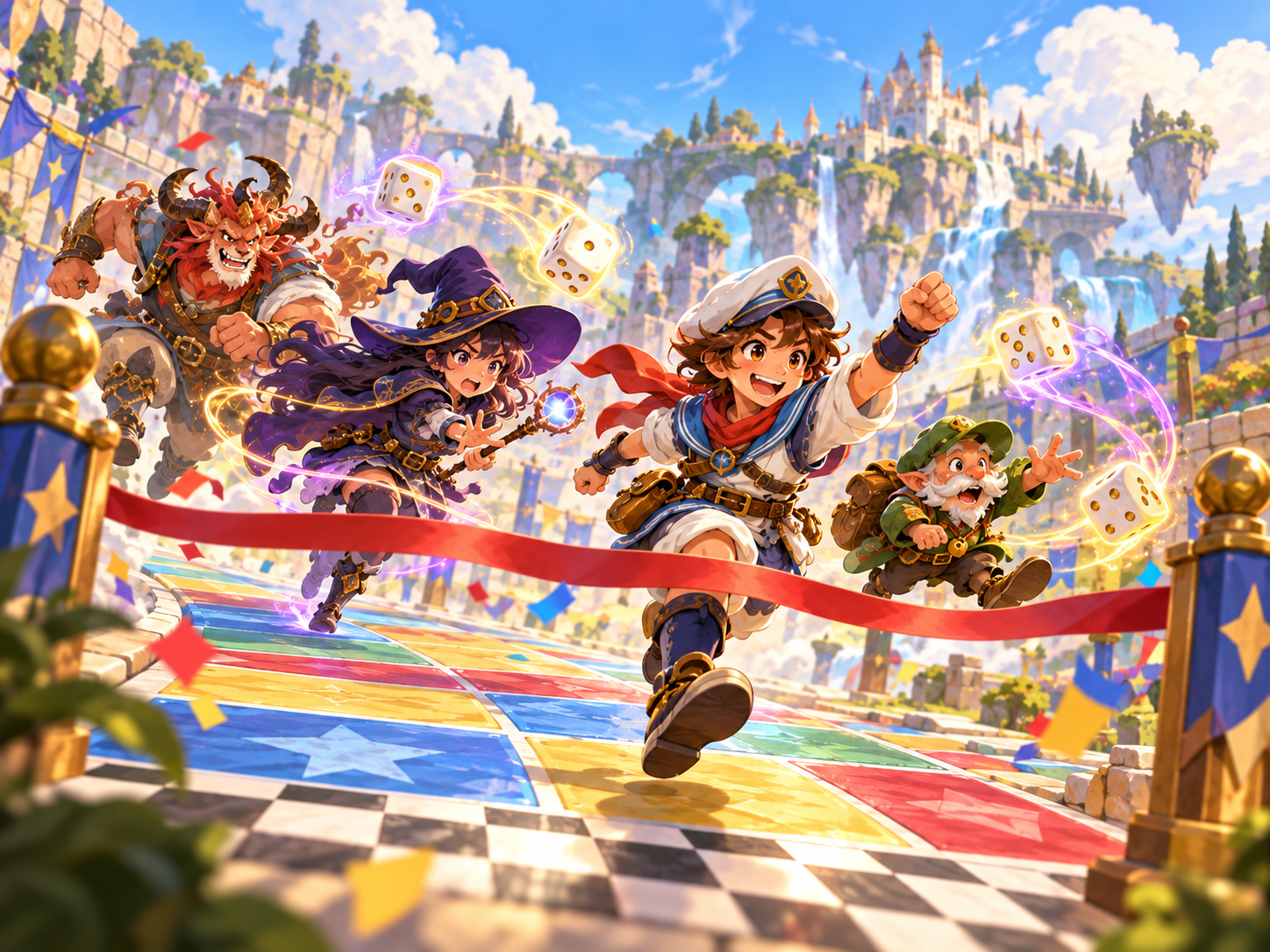
Dice and a deliberately unruly roster make outcomes uncertain. These are planning principles drawn from the four-race structure, not guaranteed combinations.
- Draft a four-race team. Look for different ways to compete, rather than four racers that need the same favorable circumstance. A power that helps when behind can balance a frontrunner.
- Value reliable triggers. When choosing between two appealing racers, ask how often each ability can actually occur in a crowded race. A spectacular power with a rare condition may be weaker than a modest effect that triggers repeatedly.
- Watch the finishing order, not only first place. Second place can score. If a lead is out of reach, a safe route to second may beat an all-or-nothing attempt that drops you out of the awards.
- Save the right racer for the right crowd. Passing and proximity powers become more interesting when several opponents share spaces or trade places. A racer that needs traffic may be ill suited to a thin heat.
- Keep the points table in view. After each heat, compare the gap in total points with the awards still available. That tells you whether a steady finish is enough or whether you need a riskier upside play.
- Read exact timing before a crucial move. Distinguish your main move from a power-induced repositioning. A chained trigger can decide a race, and the updated official rulebook is the authority for simultaneous effects.
A four-race planning example
Imagine that your drafted team has four different strengths: one racer moves reliably, another becomes stronger around nearby competitors, a third benefits when trailing, and the fourth has a powerful but unpredictable effect. These are illustrative roles, not specific racer-card descriptions.
| Heat | Illustrative choice | Reason to consider it |
|---|---|---|
| Race 1 | Reliable mover | Establish a baseline result while learning opponents’ choices. |
| Race 2 | Crowd-dependent racer | Use it when its proximity effect seems likely to matter. |
| Race 3 | Comeback specialist | A trailing-position ability may help in an unfavorable race. |
| Race 4 | High-variance racer | Consider its upside if your points deficit means second place may not suffice. |
How to use this example: Reassess after each race. If you lead the points table, prioritizing a dependable scoring opportunity may be better than chasing a spectacular first place. If you trail, a racer with greater upside could be worth the risk. Because every player selects racers for each heat, no fixed ordering is guaranteed to work.
This planning exercise concerns team selection, not detailed movement rulings. For exact interactions, consult the Magical Athlete rules FAQ.
Strategy reminder: A crowded heat changes the value of passing and nearby-racer powers. For the full player-count comparison, see Player counts: what changes?.
Editions, Updates & Expansion Notes
Is this the original Magical Athlete?
This page covers CMYK’s 2025 edition, with updated design credited to Richard Garfield. Earlier Magical Athlete printings use different components and rules. When researching a power or a scoring example, check that the answer refers to your edition; an older rulebook can be misleading for the new roster.
Which rules should I use?
CMYK’s current How to Play file was updated in August 2026. Keep it handy for power timing and clarifications, especially if your copy contains an earlier sheet. The printed card text and any publisher correction should be compared with the version you own.
Do I need an expansion?
No. The four-race meet is complete in the base box. Fan-made racers and house rules may be available online, but they are separate from the CMYK core game. Check the publisher’s product page for confirmed retail additions instead of assuming a community file is official.
What comes in the box?
The 2025 game includes a double-sided track, a large roster of racer cards and wooden figures, six dice, and point awards. For an exact inventory or replacement-part question, use the contents list in the current CMYK rules.
Magical Athlete FAQ
How many racers do I need to draft?
Four per player for the CMYK four-race game. Each goes into one heat.
Is it only luck?
Every normal move uses a die, but the draft, which racer to enter, power timing and the choice to chase first or secure second create planning decisions. There is substantial variance.
Can six people play?
Yes. CMYK lists 2–6 players. Allow more time to read powers and resolve interactions at a full table.
Is there a solo mode?
The publisher does not list an official solo mode.
Is the 2025 game the same as the older edition?
No. Use the CMYK rules and components for this guide; do not import older roster or scoring assumptions.
Sources & Editorial Note
Publisher facts, age and design credits: CMYK’s Magical Athlete page. Procedure and power timing: CMYK’s current How to Play rulebook file. The four-race format and scoring are detailed in that current rulebook. This guide paraphrases the rules; strategy and player-fit comments are editorial inferences, not playtest findings. Publisher references reviewed October 2026; verify any subsequent publisher revisions before play.