
How to Play Magical Athlete
A practical step-by-step guide to setup, recruiting racers, taking turns, resolving powers and scoring all four races.
Start with the right edition
This guide covers CMYK’s 2025 Magical Athlete edition and uses the rules updated in August 2026. Older editions differ. For disputes about individual racers, consult the rules FAQ and the publisher’s latest official document.
Artwork note: Illustrations are original fictional racing scenes, not official board positions or component photography.
Quick start: Magical Athlete in six steps
If you are teaching the game for the first time, use this checklist as an overview. Follow the full sections below for recruitment order, special spaces, timing and scoring.
- Set up: choose the starting track, prepare racer cards and matching pieces, dice and point chips.
- Recruit: draft a roster of four racers under the rules for your player count.
- Enter a heat: everyone secretly selects an unused racer, reveals together and places it at Start.
- Take turns: perform the main move and resolve the relevant track and racer effects in the specified order.
- Award points: when the second racer finishes, award the available placement chips and prepare the next heat.
- Finish the meet: after four races, total all earned point chips; the highest total wins.
Playing with two? The recruitment and racer-turn procedure changes. Use our two-player rules alongside this overview.
Goal of the game
Magical Athlete lasts four races. Before racing, every player recruits four racers, then uses one different racer in each race. The game ends after race four, and the player with the most points wins. If players tie on points, the current rules treat the result as a shared victory.
The core race is deliberately simple: roll a die and move. The complexity comes from each racer’s power and from how those powers interact.
Set up the game
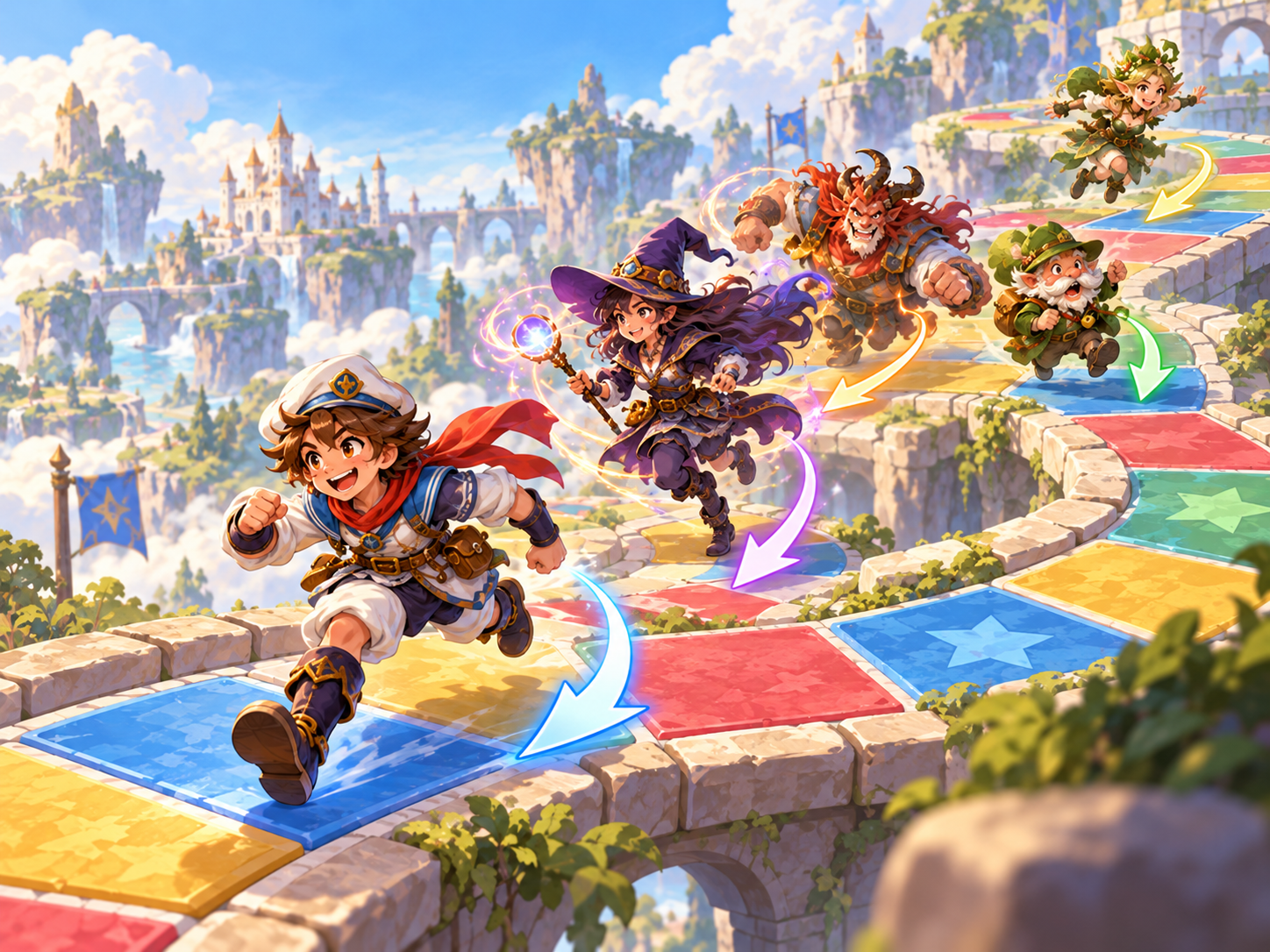
- Place the racetrack in the middle of the table with the Mild Mile side face up.
- Take out the point chips. Stack the gold first-place chips and silver second-place chips with the larger-value chips underneath the smaller-value chips.
- Shuffle the racer deck and keep it nearby.
- Put the wooden racers within reach.
- Give every player one die.
The normal game supports 3–6 players with the standard recruitment procedure below. Two players use a dedicated variant with eight racers per player.
Recruit four racers
Reveal twice as many racer cards as there are players:
| Players | Cards revealed |
|---|---|
| 3 | 6 |
| 4 | 8 |
| 5 | 10 |
| 6 | 12 |
Everyone rolls a die. The highest unique result drafts first; resolve ties according to the rulebook’s roll-off procedure. Players then snake draft: go around the table in order, and when the last player chooses, reverse direction so that player chooses again.
After everyone has two racers, reveal a fresh set and run a second snake draft, beginning with the player to the left of the original starting player. Everyone finishes recruitment with four racers.
Why this matters: each racer can enter only one race. You are drafting a four-race roster, not choosing one permanent character.
Start a race

Before race one, roll off to determine the starting player. Everyone secretly chooses one unused racer card, then reveals simultaneously and places the matching wooden racer on the Start space.
Later races are worth more points, so the order in which you spend your four racers matters. The current rules alternate tracks: Mild, Wild, Mild, Wild.
Your main move
On your turn, roll your die and move your racer that many spaces. The rules call this your main move. That term is important because many powers care specifically about a main move rather than any movement.
A racer can also move because of powers, track arrows or other effects. Those movements are not automatically main moves.
Example: if an effect moves your racer two spaces after your die movement, a power that triggers only from a main move does not necessarily treat those extra two spaces the same way.
Optional and mandatory powers
If a racer power says you can do something, it is optional. Other powers are mandatory unless the card or rules say otherwise.
When several effects need to resolve at the same time, use the current rulebook order:
- racetrack spaces;
- the current player’s effects;
- other players’ effects, proceeding clockwise.
This timing rule prevents the table from choosing the most favorable order after seeing what happens.
Passing, stopping, tripping and warping
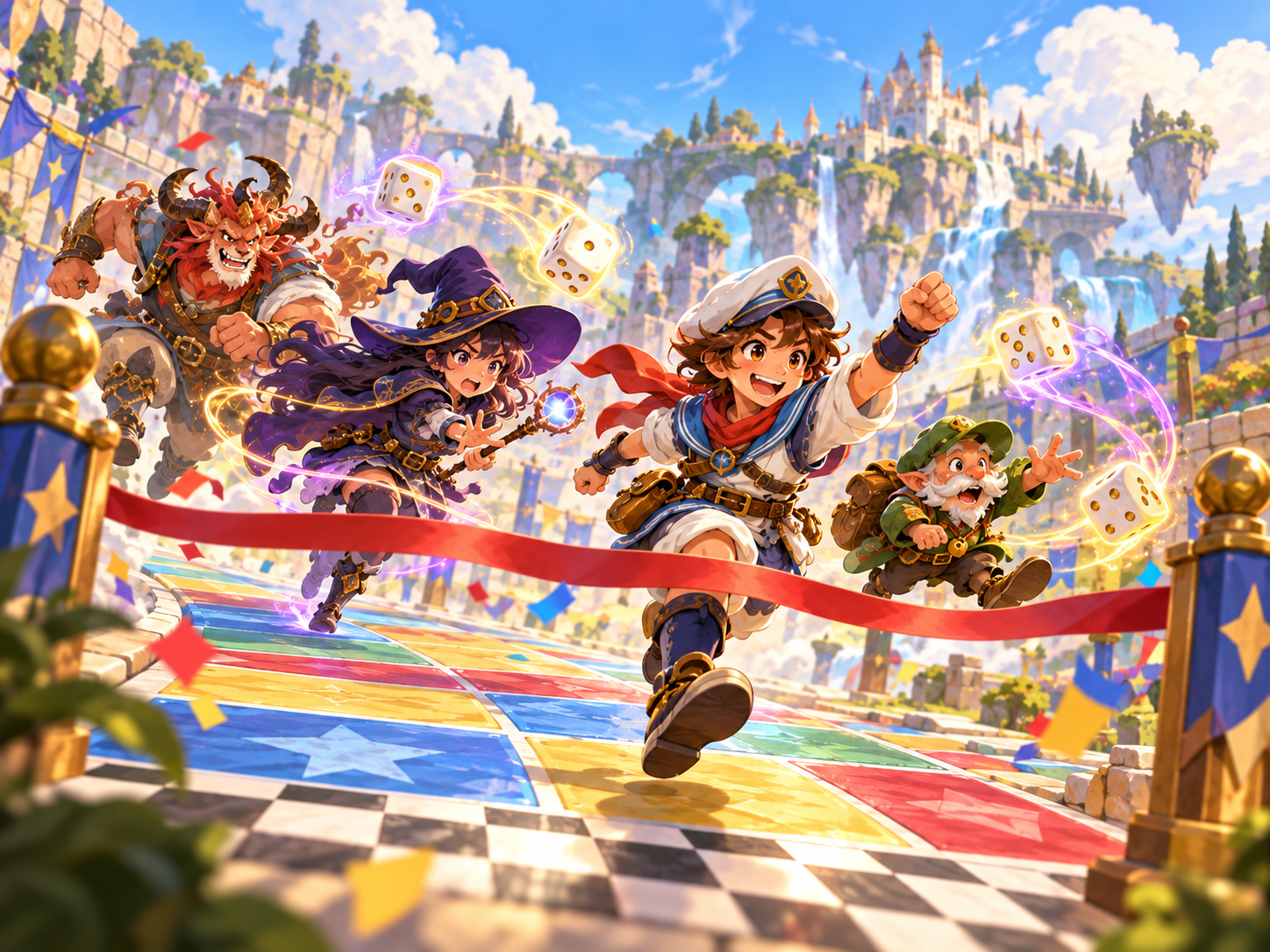
Passing means a racer begins a single move behind another racer and ends that same move ahead of them. Merely moving through an occupied space is not the same thing as stopping there.
Stopping on a space happens after a racer completes movement or otherwise arrives at that space. The August 2026 update clarified interactions involving racers arriving simultaneously, so use the current rulebook rather than an older printed explanation when a power depends on stopping together.
Trip: a tripped racer completes the current move, then lies face down. On its next turn it skips the main move, stands back up, and can still have powers trigger or move through other effects.
Warp: move the racer directly to the destination. A warp does not count as ordinary movement for passing or movement-triggered effects.
The Wild Wilds track
Races two and four normally use the Wild Wilds side. Its special spaces add three common effects:
- Arrow: move the number of spaces shown in the arrow’s direction. This is a separate move, not part of the main move.
- Rock: the racer trips.
- Star: take a bronze 1-point chip.
Because arrow movement is separate, it can create different power interactions from the die-based main move that brought the racer onto the arrow.
Mild Mile vs Wild Wilds: what changes?
Both tracks use the same core race structure. The key difference for new players is how many track-space effects they must monitor.
| Track | Normal schedule | What to watch |
|---|---|---|
| Mild Mile | Races 1 and 3 | Main moves and racer-power interactions |
| Wild Wilds | Races 2 and 4 | Arrow movement, rocks that trip racers and stars that award bronze chips |
The official rulebook allows a different track schedule if players agree before the game. Track icons should be resolved using the detailed instructions below, rather than treating this comparison as a complete set of rules.
Rerolls
If a racer rerolls a die, the previous roll is treated as if it never happened. It does not trigger effects based on the discarded result. The current rules also specify that a reroll effect applies only to the most recent die roll unless stated otherwise.
This matters for racers such as Magician and for powers that react to particular numbers.
Worked example: from choosing a racer to scoring a heat
This fictional example follows a standard three- to six-player heat on the Mild Mile; the two-player variant has different recruitment and turn procedures. It demonstrates the sequence of play, not an exact simulation of a named racer’s card or an official board position.
- Choose: Each player secretly selects one unused racer card from their drafted team. Everyone reveals together and places the corresponding wooden figure on Start.
- Begin: The starting player takes a turn and rolls a 3. With no modifying power in this example, that racer’s main move advances three spaces.
- Continue: Other players take turns in order. If a power or position interaction occurs, resolve it at the timing specified in the current rules before play continues. A power-induced move is not necessarily another main move.
- Finish: One racer crosses the finish first, but the heat continues until a second racer crosses. At that point the race ends immediately.
- Score: Award the top available gold chip to first place and the top available silver chip to second place, subject to any applicable racer-specific exceptions. Record the printed chip values.
- Prepare the next heat: Remove used racers, switch to the scheduled track and choose new unused racers. After all four heats, add every player’s collected point chips to determine the winner; tied highest totals share the victory under the current rules.
Why this matters: The first finish does not end a normal heat. Remember to record the actual award-chip values, because later heats have different rewards. For a specific power interaction, consult the Magical Athlete rules FAQ.
End a race and award points
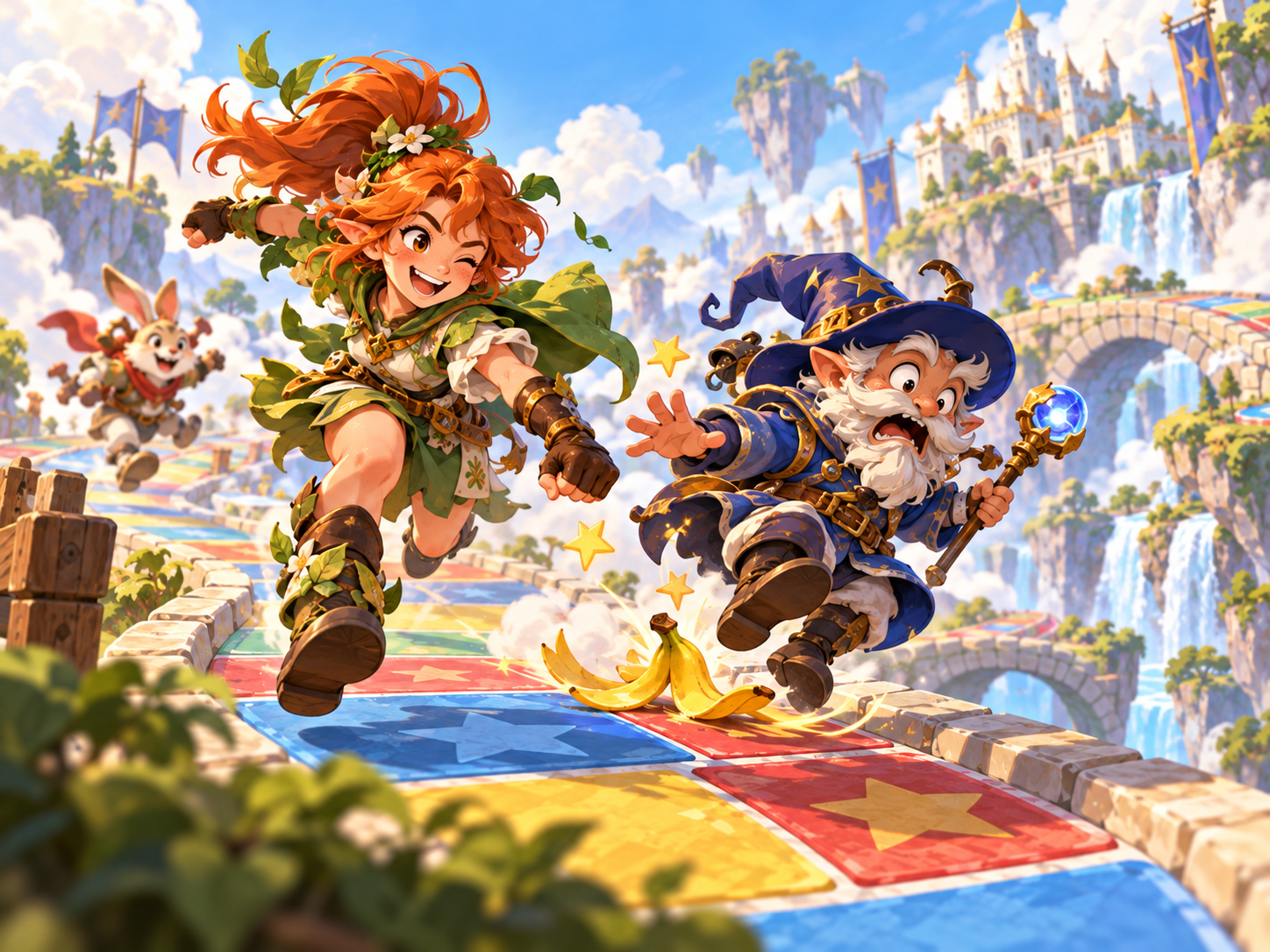
The race ends immediately when the second racer crosses the finish line. The first finisher takes the top gold first-place chip; the second finisher takes the top silver second-place chip.
The chips are stacked so later races expose higher-value awards. Always score the printed value on the chip actually taken rather than assuming every first-place or second-place finish is worth the same amount.
After the race:
- remove the racers and cards used in that race from play;
- flip the racetrack to the other side;
- everyone reveals another unused racer;
- the player whose racer was farthest behind — or first eliminated — in the previous race starts the next race.
Final scoring
After the fourth race, add the values of all point chips you collected. This includes placement chips and any bronze point chips gained through track spaces or racer powers. Highest total wins; ties are shared.
Some racers can alter the normal scoring flow. For example, a power may award points during the race or affect whether a second-place award is available. Resolve those explicit powers before doing the final total.
Common first-game mistakes
- Using a racer twice. Each drafted racer is for one race only.
- Treating every movement as a main move. Powers, arrows and warps can create different movement types.
- Resolving simultaneous effects in a convenient order. Track, current player, then other players clockwise.
- Rolling while tripped. A tripped racer skips its next main move rather than rolling and ignoring the result.
- Keeping an old die result after a reroll. A replaced roll is treated as though it never happened.
- Playing all four races on the same side by accident. The default schedule is Mild, Wild, Mild, Wild, although the rulebook allows groups to agree on a different schedule before play.
Sources and scope
Checked 6 October 2026 against CMYK’s Magical Athlete rulebook file, updated August 17, 2026, and CMYK’s official product page. Rule explanations and examples are original editorial summaries, not reproduced rulebook text or firsthand playtesting claims. Editorial policy and corrections.