
 BoardGameArchive
Dune: Imperium – Uprising
A standalone strategy game combining deck-building, worker placement, faction influence and dramatic conflicts on Arrakis.
A standalone strategy game combining deck-building, worker placement, faction influence and dramatic conflicts on Arrakis.
🏆 Quick verdict
Dune: Imperium – Uprising is a standalone competitive strategy game set on Arrakis. Players combine worker placement and deck-building to gain influence with powerful factions, deploy forces to Conflicts and accumulate victory points. Each card can help send an Agent to the board or contribute to a later Reveal turn, making timing and opportunity cost central to play.
Best suited to: people who enjoy interactive strategy, contested objectives and planning around a changing board. Less suitable for: groups seeking a light first-time board game or conflict-free engine building. You do not need to own the original Dune: Imperium.
Meaningful Agent-versus-Reveal choices; tension between deck quality and board access; spies and sandworms provide distinctive tactical opportunities.
Rules-heavy for beginners; combat is highly contested; six-player play follows a different team format rather than the regular free-for-all.
📖 How to play
Illustration note: Images on this page are AI-generated artistic impressions, not photographs or diagrams of the actual game components.
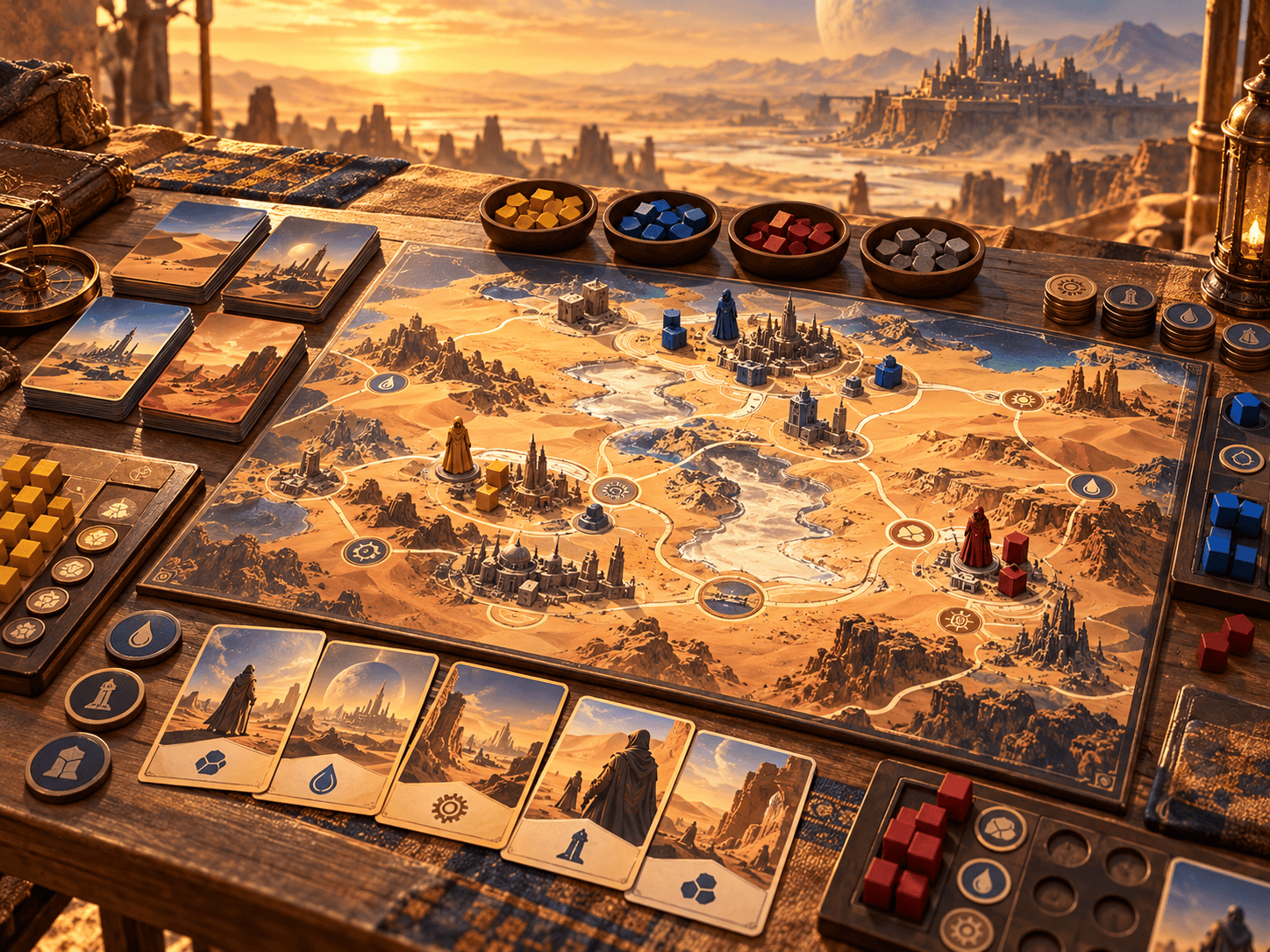
Players lead political and military factions seeking victory points through alliances, influence, combat rewards and card or board effects. Each round, players alternate Agent turns, spending cards to send Agents to unoccupied permitted locations. Instead of placing another Agent, they eventually take a Reveal turn using the cards still in hand.
The critical decision is which cards to spend on Agent placement and which to save for Reveal. Placing an Agent might secure resources or conflict forces now; keeping a card could increase persuasion and improve what you acquire for future rounds.
⚙ Setup overview
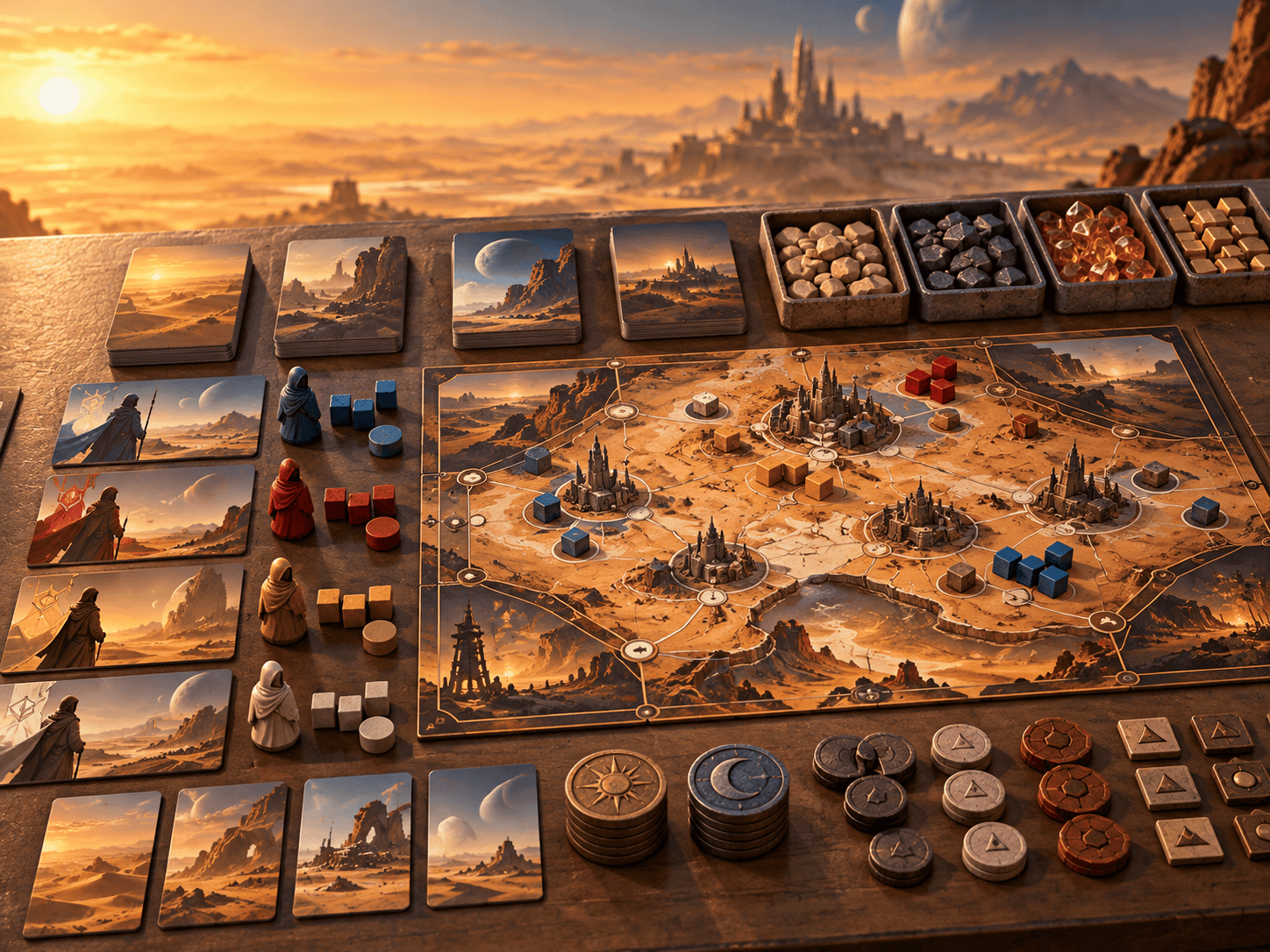
This checklist helps you organize the table before consulting the complete setup diagrams. It is not a substitute for the official component counts, starting resources or Rivals/team instructions.
- Choose the correct mode. Standard three- or four-player games use the main rules; solo and two-player games add Rivals instructions; six-player games require the team supplement.
- Prepare the shared board. Set out the reserves, faction areas, Imperium Row, accessible cards and Conflict deck in the arrangement specified for your mode.
- Prepare players. Choose leaders and supply the corresponding starter decks, Agents, markers and resources as specified by the rulebook.
- Set up Uprising systems. Follow the official placement rules for spies, sandworms, the Shield Wall and board-space resources; do not infer positions from the original artwork on this page.
- Select optional content. Decide whether to include CHOAM contracts before the game. Without that module, follow the rulebook’s alternative effect for contract icons.
- Check your opening state. Confirm influence markers, initial hands and first-player designation against the rulebook before beginning Round Start.
Edition note: The original Dune: Imperium and Uprising have different spaces and systems; use the Uprising rulebook. The six-player game uses separate team rules.
↻ The five phases of a round
Each round follows five phases. In Phase 2, players alternate turns, but the separate Reveal action is not an additional round phase.
Reveal the new Conflict card and prepare for the round according to the rulebook.
Take Agent turns or your Reveal turn. Cards committed to Agents are not available for Reveal.
Resolve combat effects, strengths, ties and Conflict rewards; check battle icons where applicable.
Add bonus spice to eligible Maker spaces without Agents.
Check whether the game ends; otherwise retrieve Agents, pass first player and begin again.
Example: play an Agent now or save the card?
Suppose a card could send your Agent to a useful board space, but keeping it would provide persuasion in your Reveal turn. Spending it for the Agent location may give you resources or board access immediately; keeping it may let you afford a stronger Imperium card. Neither is always correct: compare the board-space reward with the expected benefit of the purchase and whether the new card will cycle through your deck before the game ends.
Rules distinction: Some board spaces require resources, influence or specific icons. The illustration and example above describe a decision framework, not an exception to those requirements.
For exact turn-by-turn instructions, use the How to Play Uprising reference.
⚔ Spies, sandworms and conflict

Uprising’s spy network can influence access to occupied locations and draw opportunities. Sandworms create particularly consequential conflicts, potentially multiplying reward value in the circumstances defined by the rulebook. Neither system is simply an automatic bonus: positioning, available cards, the Shield Wall and the current conflict all matter.
Decision example: You are a contender in the current conflict, but you could spend another Agent action acquiring a resource rather than adding strength. The right answer depends on the actual revealed reward, enemy forces and whether sandworm participation changes the value of winning. Always calculate the conflict using the printed rules, not the appearance of an illustration.
Read the Uprising strategy guide for more on combat timing, spies and sandworms.
Worked example: a contested Conflict
Imagine two players each finish combat with strength 8, the highest result. Both take the second-place reward; no one takes the first-place reward or wins the Conflict card. With three or fewer players, nobody else receives a reward in this situation. With four players, if exactly two tie for first, the remaining players compete for the third-place reward.
Sandworm reminder: When a player has one or more sandworms in the Conflict, eligible rewards are doubled. Taking control of a location and battle icons on a won Conflict card are not doubled. Sandworms cannot enter a Conflict protected by the Shield Wall. Always check the current Conflict and relevant rules before applying a bonus.
★ Scoring and victory

The central objective is to gain victory points, from board achievements, faction alliances, combat rewards and other effects. The timing of final scoring matters: an apparent lead may change when end-of-game effects are resolved.
Before deciding the winner, verify each player’s VP track position, any VP tokens or cards that count, and all applicable endgame effects. Do not assume that leftover resources universally convert to victory points.
For exact VP sources and end triggers, use the dedicated Uprising scoring reference.
Exactly when does Uprising end?
During Recall, the endgame is triggered if at least one player has 10 or more victory points or the Conflict Deck is empty. Resolve applicable Endgame Intrigue cards before determining who has the most victory points. Remaining resources do not automatically turn into victory points, but they can decide a tie: compare spice, then Solari, then water, then troops in garrison.
Example: If a player reaches 10 VP during Combat, the round still proceeds through the appropriate remaining phases and the endgame check. Do not declare the winner the moment the marker reaches 10.
📚 Essential terms for new players
Knowing these terms makes the main rulebook much easier to follow. They describe how the standard game operates; card text and player-count supplements may add specific exceptions.
- Agent turn
- Play a card, use its Agent icons to send an Agent to an eligible board space, and resolve the placement.
- Reveal turn
- Reveal remaining cards to gain their Reveal effects, including persuasion used to acquire Imperium cards.
- Influence and alliance
- Progress with the four factions can earn victory points and allow players to contest alliance tokens.
- Conflict
- The round’s contest for rewards, resolved after player turns using combat strength and the tie rules.
- Battle icons
- Crysknife, Desert Mouse or Ornithopter icons. When you win a Conflict, matching its icon with another face-up Conflict or Objective card in your supply lets you flip that pair face down to gain 1 VP.
- Spies
- A Uprising mechanism for information and access; see the detailed rules guide for placement and withdrawal.
💡 Four decisions that shape your strategy
Uprising rewards players who adapt their plans to the board, opponents and number of rounds remaining. These principles help you assess a turn; for deeper spy timing and combat tactics, visit the dedicated Uprising strategy guide.
1. Decide what your next Reveal must accomplish
Before committing another card to an Agent, ask what you hope to buy or achieve when you Reveal. If one more Agent placement leaves you unable to afford a useful card, the immediate board-space reward needs to justify that loss. Conversely, preserving every card for persuasion can mean missing scarce board actions.
2. Treat faction influence as a contested investment
Advancing with a faction can help earn points and secure an alliance, but your rivals can challenge that position. Check the current influence track and likely responses before spending several actions trying to control multiple factions at once.
3. Compare this Conflict reward with your future options
A strong reward can justify extra troops or a sandworm; a marginal reward may not. Ask whether your commitment is likely to change your placing and what resources or tempo it sacrifices next round. The scoring reference explains how Conflict rewards relate to victory points.
4. Change priorities as the endgame approaches
An engine-building purchase is useful only if you have enough turns left to benefit from the new card. Near the end, secure VP opportunities, protect achievable alliances and avoid expensive moves with no realistic return.
A 30-second planning checklist
- What is the best attainable reward this round?
- Which board spaces can opponents take before my next turn?
- Which cards must stay in hand for my intended Reveal?
- Can I meaningfully change the Conflict result?
- Am I investing for later rounds, or should I pursue VP now?
♟ Which player-count mode should you use?
Before playing, check the correct official supplement for your table size. These modes are not identical configurations of the standard rules.
| Players | Mode | Main difference |
|---|---|---|
| 1–2 | Rivals | Uses the Rivals rules supplement. |
| 3–4 | Standard | Competitive free-for-all using the main rulebook. |
| 6 | Teams | Two teams of three, with Commander and Ally roles under separate rules. |
? Frequently asked questions
Is Uprising an expansion?
No. It is a standalone game, though players may want to investigate compatibility with other Dune: Imperium releases.
Are CHOAM contracts mandatory?
No. CHOAM contracts form an optional module. Without that module, a contract icon gives you 2 Solari instead. Dire Wolf recommends learning the base game before adding contracts.
What changed from the original Dune: Imperium?
Uprising reworks the board and card environment and adds major systems such as spies and sandworms. See our comparison of the two games.
Can you play solo, with two players, or with six?
The standard multiplayer game is designed for three or four players. One- and two-player sessions use the official Rivals supplement. Six players use the separate team variant, with two teams of three and additional Commander/Ally rules.
Do you add the strengths of teammates in six-player Combat?
No. The two Allies on the same team compete in a Conflict separately. The Commander has a distinct role and does not win Conflict rewards.
What happens if players tie for first in Combat?
Tied players receive the second reward, and no one wins the Conflict card. The remaining rewards depend on player count and the number of tied players; refer to the official tie rules for the specific case.
Do sandworms double every type of reward?
No. There are exceptions, including taking control of a location and battle icons on Conflict cards. Consult the official rulebook for reward-specific handling.
When does the game finish?
The endgame is checked in the Recall phase when a player has at least 10 VP or the Conflict Deck has run out.
🔗 Related guides and official sources
- Detailed how-to-play guide
- Scoring and victory reference
- Strategy: spies, worms and combat
- Expansion compatibility
- Original versus Uprising comparison
- Publisher rulebooks and reference materials
Independent BoardGameArchive guide. The artwork on this preview is generated illustrative material, not official photography, product components or an endorsement by the publisher. Rules should be checked against the official Uprising printing before final publication. Editorial policy.